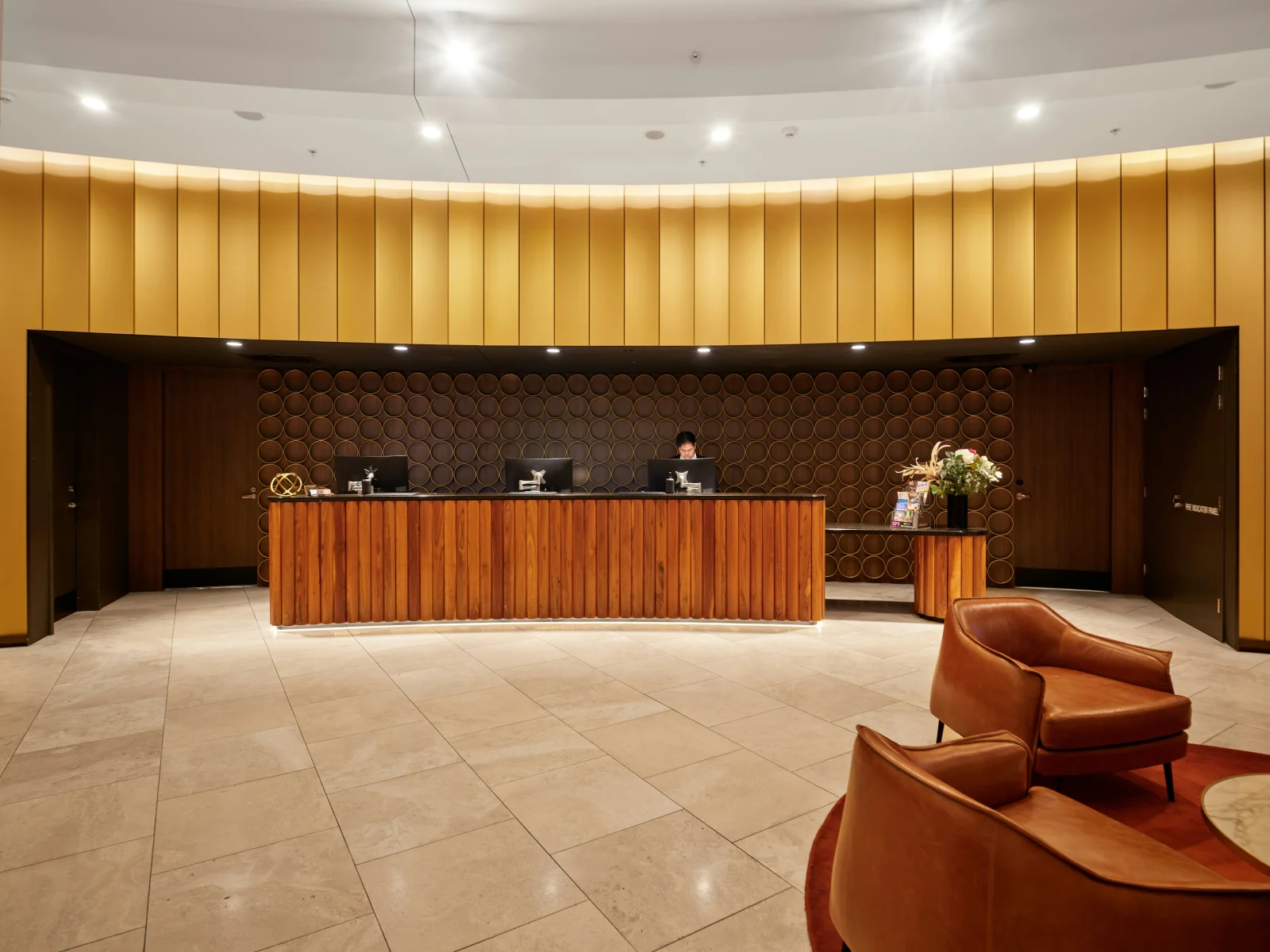
Most independent hotels focus their commercial energy on the initial booking, then treat the stay as a purely operational matter. Yet, it is precisely during the stay that guests are most receptive to targeted value propositions. Hotel upselling is not about aggressive sales tactics; it is about identifying moments when a guest is naturally open to enhancing their experience—and offering them the right option, at the right time, in the right format.
The potential is significant: a guest who is already on-site has already overcome the psychological barrier to purchase, is familiar with your property, and is often looking to optimize their stay. The goal is not to maximize the average basket at any cost, but to transform latent intent into a seamless transaction, without friction or any sense of manipulation.
In-stay upselling: the overlooked revenue potential for independent hotels
Most establishments treat the stay as a passive phase: the guest has paid for their room, and everything else is just service. This mindset leaves a wealth of direct revenue on the table, with no additional acquisition costs. Unlike acquiring new customers, in-stay upselling engages an audience that has already converted, resulting in a structurally higher conversion rate.
Chain hotels have industrialized this practice through their apps and centralized systems. Independent hotels, however, have a decisive advantage: the ability to build personal relationships and customize offers in real time. But this advantage only pays off if the establishment structures its levers, touchpoints, and proposal tools effectively.
In-stay upselling does not replace your initial pricing strategy; it complements it. It captures intentions that emerge after booking—a birthday to celebrate, an unexpected meeting, a desire to extend a stay, or a need for extra comfort. These intentions exist, but without a structured approach, they remain invisible or unmonetized.
Room upgrades, ancillary services, and extensions: prioritizing your levers
Not all upselling levers are created equal. Some generate high marginal revenue with little operational friction, while others require significant resources for limited impact. Prioritization should be based on three criteria: incremental margin, ease of execution, and customer perception.
Room upgrades remain the most profitable lever when occupancy allows. An unoccupied superior room generates zero revenue; offered to a guest already on-site, it produces almost pure additional income. Timing is critical: the offer should be made before arrival (pre-stay email) or at check-in, never after the guest has settled in. The guest must perceive the upgrade as an opportunity, not as a correction of their initial choice.
High-margin ancillary services —such as breakfast, parking, spa access, or premium room service—work well when bundled or offered in response to an expressed need. A guest asking where to park their car is receptive to a parking offer. A guest checking spa hours is open to a wellness package. The key is to capture the signal of intent, not to bombard every guest with every option.
Extending a stay generates the highest incremental RevPAR, but requires availability and foresight. A satisfied guest in the middle of their stay is the ideal target: they know the property, have validated the quality, and may have professional or personal flexibility. The proposal must be proactive (via an app or the front desk), with a clear pricing incentive if future occupancy is low.

Timing and tone: making offers at the right moment without degrading the experience
Poorly calibrated upselling destroys more value than it creates. A guest approached at the wrong time, with the wrong tone, perceives the proposal as an attempt to extract money rather than a service. Timing and tone are the two critical variables for conversion.
The pre-stay period (24 to 48 hours before arrival) is the optimal time for upgrades and predictable services. The guest is in a planning phase, mentally available, and appreciates it when you anticipate their needs. A personalized, understated email with a single offer and a clear benefit converts better than an exhaustive catalog.
Check-in is the second strategic touchpoint, but only for immediate-value propositions: upgrades if available, breakfast packages, parking. The proposal should be framed as a convenience, not a sales pitch. "We have a room with a view available tonight" works better than "Would you like to upgrade your room?"
During the stay, proposals should be triggered by behavioral signals: browsing the room service menu, asking for information about the spa, or searching for local activities. A well-configured chatbot or a trained front-desk team can turn these micro-intentions into seamless transactions. The push approach (unsolicited solicitation) should be reserved for offers with high perceived value and low frequency—an exceptional gourmet dinner or an exclusive spa treatment.
The tone must remain consultative, never transactional. "I see you're looking at our spa menu; I can book a preferred time slot for you" outperforms "Take advantage of our 20% off spa offer." The guest should feel that you are making their life easier, not selling them a product.
Lightweight technologies for upselling: chatbot, mobile app, front-desk training
In-stay upselling does not require a complete PMS overhaul or heavy investment. Three lightweight, combined solutions cover most use cases.
A web or WhatsApp chatbot allows you to offer services and upgrades in response to common questions. A guest who asks, "What time does breakfast open?" receives the information, followed by a direct booking offer if it is not included. The chatbot captures latent intentions without tying up the front desk and can operate 24/7. Integration with the PMS allows for real-time availability checks and transaction processing.
A lightweight mobile app or web app (no native development required) centralizes the in-stay offering: room service, spa booking, extension requests, and available upgrades. The app must be clean, fast, and action-oriented. Guests don't download an app to browse generic information, but to obtain immediate service. Push notifications, used sparingly, can follow up with a targeted offer ("Your room can be extended until 2 PM tomorrow").
Front-desk training remains the most underestimated lever. A receptionist trained to detect intent signals and formulate non-intrusive proposals converts more effectively than a poorly calibrated automated system. Training should cover: opportune moments, effective phrasing, handling objections, and prioritizing levers based on the guest profile. A rigid script fails; a contextual decision-making framework works.

Measuring impact: from proposal to actual incremental RevPAR
In-stay upselling is not measured by the volume of proposals sent, but by the additional revenue generated per guest. Three metrics structure the management process.
Conversion rate by lever : how many upgrade proposals result in a transaction? How many guests contacted during the pre-stay phase accept an extension? A low conversion rate signals either a timing issue or a problem with the offer (price, relevance, phrasing). Segment analysis (leisure vs. business, first-time vs. repeat guest) refines the diagnosis.
Incremental revenue per stay : how much does each stay generate beyond the initial booking? This metric should be tracked as a trend, by acquisition channel and guest profile. Does a direct guest generate more upsell revenue than an OTA guest? Is a long stay more monetizable than a short one?
Impact on overall RevPAR : in-stay upselling must translate into a measurable improvement in RevPAR, not just ancillary revenue. If upselling cannibalizes initial bookings (guests who book the base room counting on an upgrade), the net impact is zero. Analysis must isolate the specific effect of the upsell by comparing cohorts with and without the system in place.
Measurement must also incorporate customer satisfaction: an upsell that lowers your NPS or generates complaints destroys more value than it creates. The balance between monetization and experience is the true performance KPI.
Building a sustainable upsell system
In-stay upselling is not a one-off tactic, but an operational system integrated into the guest experience. Successful establishments don't just bombard guests with offers; they structure touchpoints, train their teams, and measure the actual impact. The potential exists in every stay—it just needs to be made visible, accessible, and desirable. Independent hotels have the relational strengths to achieve this, provided they move from opportunism to a methodical approach.